Spring is a New Beginning! Joan Walsh Anglund
March 27, 2010

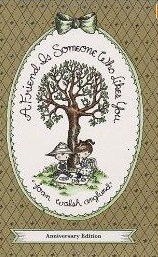
Does this look familiar to any of you? Any pangs of nostalgia? This treasure, “Spring is a New Beginning” was written and illustrated by Joan Walsh Anglund and is one of more than 75 books she has written beginning in 1958 with “A Friend is Someone Who Likes You”. Other favourites include “What Color is Love?” and “Love Is A Special Way of Feeling”. She is also known for her series featuring “The Brave Cowboy”. The phrases in each of these are simple, charming and focused on important messages like “A friend is someone who likes you. It can be a boy … it can be a girl … or a cat … or a dog … or even a white mouse. A tree can be a different kind of friend. It doesn’t talk to you, but you know it likes you, because it gives you apples … or pears …. or cherries … or, sometimes, a place to swing.” (from A Friend is Someone Who Likes You)


Joan Walsh Anglund has a devoted following (more than 40,000,000 of her books have been sold!) Learn more about her and about the story behind her stories by clicking here.


The BookBook
March 24, 2010

Last week I wrote about book covers and then I came across another type of book cover I think you’ll love! A company called TwelveSouth has created the BookBook … “a novel way to cover MacBook”.
“Each BookBook is brought to life with hand craftsmanship and distressing, ensuring no two are exactly alike. From dual zippers with leather pulls, that at first glance look like bookmarks, to the sturdy reinforced hardback covers, BookBook is a vintage work of art built to protect modern day Macs. Along with classic looks, BookBook was designed to use as a traditional sleeve or to work while connected via elastic corner clips. Those dual zippers give you the option to charge your MacBook while it safely stays inside BookBook. This case is designed with good looks and smart functionality, cover to cover.”
Makes me wish I was a MacBook user!

Not a Kindle user either but thought those of you who are might enjoy this Kindle sleeve – also with a vintage book look. This one is available on Etsy.

A Book and Its Cover
March 17, 2010
Never judge a book and all that … but I admit I do! Don’t you too? Some wonderful book covers have caught my eye lately and yes, I may have even added a few of them to the Bedside Table collection – for art’s sake of course! (Had “art” capitalized but then thought you might wonder who Art was!) Click on your favourite covers to learn more about the books. I’m sure you’ll be tempted to read them! Share your favourite book covers with the rest of us … (I’ll upload the photo if you want to just send the titles)
I love these:


and this one: 
And here is the story behind its cover!

A Letter in the Mail
March 15, 2010

A recent release called Yours Ever – People and Their Letters by Thomas Mellon has captured significant attention in book shops. It seems the techno communicators of today are feeling nostalgic for the art of handwritten correspondence. This collection “reminds us all of the power and importance of the humble letter.” (Bookmarks) There have been a few “Epistolary” styled books in recent years that have achieved great success – all of them are charming but the last title in the list is my all-time favourite!

Yours Ever – People and Their Letters by Thomas Mellon

Griffin & Sabine – An Extraordinary Correspondence by Nick Bantock

The Guernsey Literary and Potato Peel Pie Society by Mary Ann Shaffer and Annie Barrows

The Wednesday Letters by Jason F. Wright

PS I Love You by Cecilia Ahern
The Jolly Postman or Other People’s Letters by Janet and Allan Ahlberg


Read an interesting interview with Allan Ahlberg.
Book Club for the Homeless
March 12, 2010

The word is their bond
From a rare friendship, a book club for the homeless is born
By Jenna Russell, Globe Staff | July 5, 2009 At the crest of Beacon Hill in a well-appointed room, the Tuesday morning book club is tearing a novel apart.
The critique, on this warm early summer day, is merciless, and as it heats up, the meeting crackles with complaints. There should have been more clues to help the reader unravel the mystery, Donnie insists. Ned, between bites of a glazed doughnut, dismisses a main character as unbelievable. Rob is irked by the same character’s inconsistencies.
“For someone who knows everything about her son, she doesn’t know a damn thing,’’ Rob says, his voice dark with disappointment.
The men drinking coffee at the round wooden table are dressed casually in sweat shirts, jeans, and sneakers. Some of their faces are lined beyond their years. But as they deftly flip through paperbacks assessing literary merit, there is no sign their lives are anything but normal.
For two lively hours every Tuesday morning, in a church meeting room with old oil portraits, they are book club members first and homeless people second.
The story of the book club, now in its 10th month, is a tale of ordinary city life upended. It began with a stunningly unlikely friendship, between two men from different worlds: Peter Resnik, a high-powered lawyer on his way to work, and Rob, a homeless man guarding a friend’s shopping cart on Boston Common. Through months of daily conversations, that began with jokes and sports talk and gradually delved deeper, they found a common interest: literature. And when they saw the bridge that they had built, they recognized its potential for others.
In a short time, they say, the book club has proved its power to reach homeless people and build their confidence. Emboldened by its success, Ron Tibbetts, a Beacon Hill church deacon and longtime homeless outreach worker, has launched plans to replicate it. His new nonprofit group, the Oasis Coalition, aims to establish dozens of small social groups citywide, filling the gaps left by large, institutional programs that offer the homeless food and shelter but little or no personal connection.
“It’s five people in a book group, not 5,000 people fed, but it’s five people I can pull aside and talk to,’’ Tibbetts said.
When talk flows at the book club, the dynamic that emerges is pure and powerful. The members are equals, linked by what they read and respected for their insights. Their discussions, held at Swedenborgian Church on the Hill, are both a stimulus and a respite for people used to staying focused on survival – where to sleep and how to stay dry – rather than the themes and symbols of fiction.
Last Tuesday, they tackled O. Henry’s “The Gift of the Magi,’’ mulling the idea of objects as identity. Donnie, 47, said he understood the insecurities of Della, the character who cuts her hair and sells it to buy her beloved a watch chain.
“When I was a kid, I wore my hair long, and I took pride in it,’’ he told the group, leaning back into a plump settee. “One night, my mother came in drunk and cut it off, right down to the scalp, and after that I wasn’t the same person anymore. My confidence went out the window.’’
A former Marine who has been homeless off and on since he developed health problems that left him unable to work, Donnie said he likes the camaraderie, and the normalcy, of the book club.
“We’re real people,’’ he said. “You see us on the street and the sidewalk, and a lot of people think the homeless are dirty and drunk, but even those people, there’s a soul in there.’’
To Peter Resnik, the downtown lawyer on his way to work, the homeless people he saw on the Common did not become real all at once. He talked to Rob and Rob’s friend Chris for months – often, in the beginning, about basketball – before he saw them as friends, and worked up the courage to ask whether they wanted to get off the streets.
Given the distance between their two worlds, it seems extraordinary that they ever talked at all. “It struck me as amazing,’’ said Rob.
Resnik, 64, woke each morning in his home in the Back Bay, where he had moved with his wife and three children from Hingham. An English major at Yale, he moved to Boston for law school and joined the global firm McDermott, Will & Emery, where he rose to prominence trying high-profile product liability cases. He represented one of the makers of the Fen-Phen diet drug, and the foam manufacturer sued by victims of the Rhode Island nightclub fire.
Tall, trim, and quietly good-humored, Resnik almost always walked to his office, on the 34th floor of a gleaming State Street tower. Whenever he had time, he took the scenic, slightly longer route through the Common.
Rob, 50, rose each day from a sleeping bag rolled out on the stained sidewalk beside Tremont Street, where he slept in the doorway of an Army recruiting station. A Woburn native, he attended Catholic high school, joined the Army, and later worked in warehouses and as a courier. Six or seven years ago, feeling overworked and exhausted, he was fired from his job for taking too much sick time, he said. He fell behind on his rent and started living on the streets.
Compact and wiry, with cropped gray hair and a shy but agreeable nature, Rob headed to the Common early every morning after being roused by the Tremont Street businesses opening.
There, on a maple-shaded walkway near the playground, the homeless man stood each day and greeted passersby, who ignored him, insulted him, or gave him money. Resnik always said hello, and one spring day two years ago, he stopped to talk.
The lawyer says he wasn’t on a philanthropic mission. He struggles to explain what it was that drew his interest. But day after day, talking with Rob and Rob’s friend, what he found was not what he expected. The homeless men kept up-to-date on sports and current events. They looked after each other, and watched out for others on the streets.
And Rob, he discovered – Rob liked to read.
Resnik brought him a copy of “Water for Elephants,’’ a novel set during the Great Depression, about a veterinary student who joins a traveling circus. Then he brought him “The Kite Runner.’’ Standing on the Common, they talked about the books. And, there the idea for the book club was born.
Resnik buys the books, Rob makes the coffee, and Tibbetts leads the discussions and recruits readers, toting extra volumes in his backpack when he roams the streets. Because their lives are unstable, the roster of participants is always changing. The club has included people staying in shelters and with friends, and others given rooms through city or state programs. The number has ranged from four or five to a dozen. The members interviewed for this story asked that their last names not be used.
Since their first meeting in September, they have read “Water for Elephants,’’ “Angela’s Ashes’’ by Frank McCourt, and “A Monk Swimming’’ by McCourt’s brother Malachy. They read “The Glass Castle,’’ a memoir by Jeannette Walls, whose tale of her neglectful parents left them deeply troubled, and at Donnie’s request, they read essays by Ralph Waldo Emerson, an assignment almost everyone else found tough slogging. Some of their best discussions centered on “All Souls: A Family Story from Southie,’’ Michael Patrick MacDonald’s memoir of his childhood in South Boston.
At the start, Resnik offered to bring lunch each week.
The founding members of the book club turned him down, and settled on coffee and doughnuts instead. They had enough free meals, they said, they wanted something else – camaraderie and stimulating talk.
“You can’t solve the problem of homelessness, but that doesn’t mean you can’t help some people,’’ said Resnik. “You can do something, with minimal sacrifice, if you stay with it.’’
For people trying hard just to find a place to sleep, a book club may be nice, but it isn’t always easy. For starters, people on the streets can’t read after dark. In shelters, noise and chaos shatter concentration. When Donnie stayed at the Long Island Shelter in Boston, he read on a bench by the showers, the quietest spot he could find in the complex.
Just hanging on to a book is difficult when you have to carry everything you own. As much as reading meant to him, said Donnie, he had to prioritize the things he needed for survival.
“If it’s a book or socks,’’ he said, “I’m pitching the book.’’
The struggle pays off, book club members said, in the rush of accomplishment they carry from each meeting.
Last week, Tibbetts told the group about a prospective member with a problem: a homeless man who longs to devour books, but reads at a fourth-grade level.
“Get him here,’’ said Donnie, as Rob nodded agreement. “It’s a good start, being here.’’
For Rob, the unexpected friendship he forged on the Common has been transformative. When Resnik learned that an old traffic ticket had blocked his homeless friend from getting a room through the city, he drove him to a court in Palmer, where he represented him pro bono and resolved the case. Because of that kindness, Rob is off the streets. He has found a part-time job as a church custodian and volunteers his time serving meals to homeless people.
Resnik, meanwhile, is helping to raise money to replicate the book club.
“You can walk by somebody who you know is going to ask you for a buck, but if you know their name, you can’t walk by,’’ the lawyer said. “You can’t sleep comfortably if someone you know is sleeping outside.’’
Jenna Russell can be reached at jrussell@globe.com. 

BookCrossing – Read and Release!
March 5, 2010

As a few friends pack up for Spring Break travels we’ve talked about the “book dilemma”. How can one head to the beach, the ski cabin, the Lido deck with just one book? Impossible! Several (4, 5, 6?) selections must be on hand which can involve some creative planning and packing. Some readers have ventured into the world of electronic tablets for reading on the road … others of us are just not there yet (if we ever get there!) One solution I love the idea of is BookCrossing. If you’ve ever had to jettison books before boarding the plane in order to avoid excess baggage charges you’ll love this concept. Read on to learn more and then Bon Voyage to you and your books!
The idea for BookCrossing came to Ron Hornbaker back in March of 2001, as he and his wife Kaori were admiring the PhotoTag.org site, which tracks disposable cameras loosed into the wild. He already knew about the popularity of WheresGeorge.com (which tracks U.S. currency by serial number), and that got him thinking: what other physical object might people enjoy tracking? A few minutes later, after a glance at his full bookshelf, the idea of tracking books occurred to him. After two hours of research on the Internet, Ron realized, to his surprise, that nothing like BookCrossing had been done on any significant scale. And so they went to work. By 3 A.M. that morning, they had decided on the name (zero hits for “bookcrossing” on Google), registered the domain, and Kaori had sketched the running book logo on a crossing sign. The rest was merely execution.
With the backing of his partners, Heather and Bruce Pedersen, Ron went to work programming the site from scratch the next day, and about four mostly sleepless weeks later, on April 17, 2001, www.bookcrossing.com was launched. Members trickled in at the rate of 100 or so per month until March of 2002 when the Book magazine article was published. Since then, BookCrossing has been the focus of countless TV, radio, and newspaper features around the world, gets about 300 new members every day, has its own category in the human-edited Google Directory, in Wikipedia, and has been added to the Concise Oxford English Dictionary as a new word. Over the past 7 years, BookCrossing has continued to grow, and move closer to making the whole world a library. It has captured the passion and imagination of over (740,000) people worldwide who help spread the bounty of books through http://www.bookcrossing.com. Read and Release!

Louisa May Alcott
March 2, 2010

Wasn’t really planning to write about Louisa May Alcott of all people today (She of Little Women & Little Men fame) but I noticed an interesting title among the new releases for this spring: The Lost Summer of Louisa May Alcott. I clicked here and there to learn a little more and things snowballed. Now the Bedside Table may have several more new titles!
Our book club read the book March a few years ago in which Geraldine Brooks (one of my favourite writers) takes the character of the father in Alcott’s Little Women (Mr. March) and imagines his story as an absent husband and father in the Civil War. We all found the story compelling and I really enjoyed the idea of taking an undeveloped character from a classic and creating his or her own story.
Also just learned the interesting fact that though Louisa May Alcott died at 55 years old in 1888, her most recent publication was in 1995. The book is called A Long Fatal Love Chase (dramatic enough for you?!) It was originally rejected for being “too long and too sensational”. I’ll link to a full description below. Thinking it might make it to the Bedside Table too and I’ll have my own “found” summer of Louisa May Alcott!

The Lost Summer of Louisa May Alcott by Kelly O’Connor McNees

March by Geraldine Brooks

A Long Fatal Love Chase by Louisa May Alcott